



Project Outcomes
Precision Irrigation with Wireless Sensors: Driving Peat-Free Production in Ornamental Horticulture
The project is funded through ADOPT (Accelerating Development of Practices and Technologies), a multi-year funding programme within the UK Defra Farming Innovation Programme, delivered in partnership with Innovate UK.
ADOPT supports collaborative grower-led, on-site trials or experiments to generate, test, and demonstrate, innovative solutions that address commercial production challenges.

Dashboard development and trigger point values
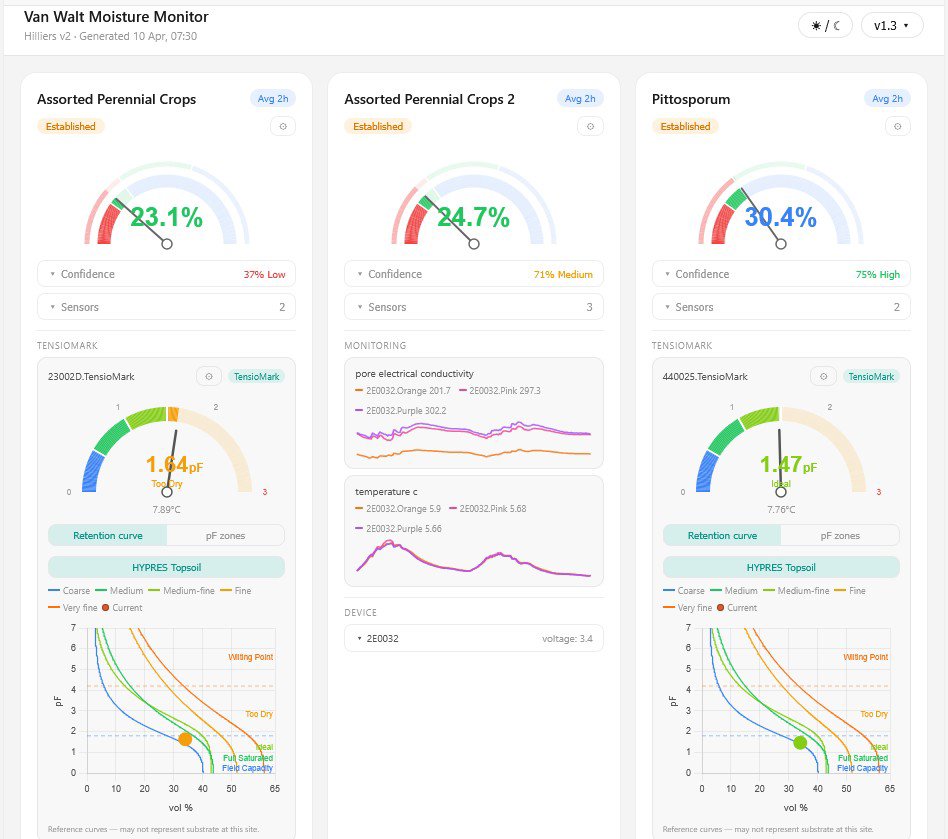
The dashboard, displays the data recorded by the in-crop sensors in near real time, and is an integral part of the crop management system. It highlights the current status and changes to the water and nutrient-linked parameters in a way that can be easily understood by the grower and converted into required crop management actions.
Knowing when to irrigate: growing medium matric potential
Water potential sensors (such as the Tensiomark) measure the growing medium matric potential, quantifying how difficult it is for the plant to extract water from the medium and therefore when irrigation should commence to prevent plant damage. The data is displayed on a logarithmic scale, pF. pF values near zero indicate that water is easily available to the plant; higher pF values indicate increasing plant stress as water becomes harder to access by the roots of the plants. Readings between 0 and 2.0 pF are colour coded on the dashboard, from blue through to red to reflect this.
The project will improve the identification of the pF trigger point value, currently extrapolated from other soil/substrate types. The dashboard also includes a moisture retention curve, illustrating the relationship between matric potential and volumetric moisture content across the full range of plant available water, from wilting point to container capacity. This allows growers to quickly check that different sensors are reporting relatable values. A more suitable partial moisture retention curve will be developed from the project.
Knowing how much to irrigate: volumetric moisture content
The volumetric moisture content is a measure of how much water there is within the growing medium. The sensors used in the project (WET 150 and Teros 12) provide a relative rather than an absolute figure, but they can be related to the level of water within a particular growing medium and displayed as a percentage. The dashboard displays insufficient (red), optimum (green), and excessive (blue) levels of moisture.
Combining sensors for better decision making
Although moisture levels can be managed by the volumetric moisture content sensors alone, combining them with the Tensiomark sensors provides detail about what is happening at the plant level. Matric potential informs when to irrigate, and volumetric moisture content informs how much.
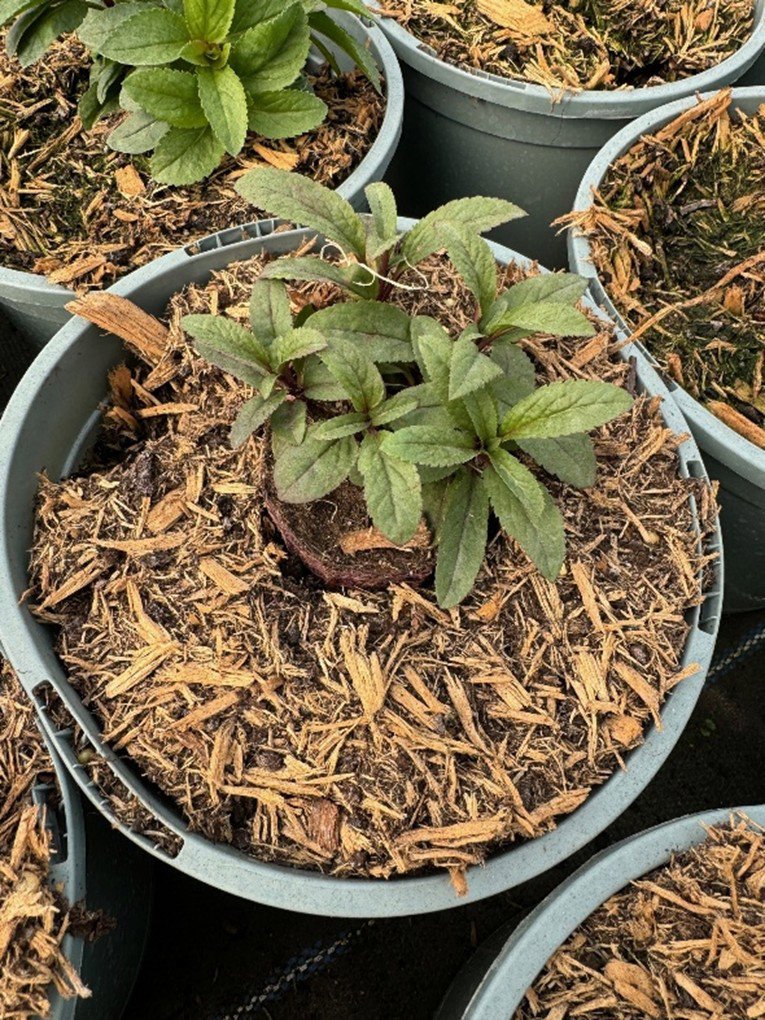
The project has already highlighted that the optimum levels will not be a constant range throughout the life of the crop, for example, a slightly more generous watering regime is required in the first two to three weeks post-planting to ensure the hydraulic connection between the plug and the fresh growing medium remains in place, allowing the young plant to establish without the plug drying out.
Monitoring nutrient availability: electrical conductivity
The growing medium electrical conductivity is another key parameter. Electrical conductivity can be measured two ways, bulk electrical conductivity (ECb) is a measure of the total conductivity of the entire growing medium, including solid particles, air spaces, and pore water contained within it; pore water electrical conductivity (ECp) is a measure of the water contained within the pores of a growing medium and represents the nutrient availability to the plant. ECp is often used to track the use of controlled-release fertiliser and support decision making on liquid fertiliser applications. Conductivity is displayed as deciSiemens per metre (dS/m).
Key outcomes for growers
- Improved irrigation timing and volumes in peat‑free growing media.
- Greater confidence in sensor‑based irrigation decisions.
- Reduced risk of crop stress during early establishment.
- Better alignment between water and nutrient management.
- Practical, dashboard‑driven insights that fit commercial workflows.
Further work within the project will focus on understanding different peat‑free growing media and improving guidance around moisture and electrical conductivity interpretation, ensuring the system delivers reliable, transferable value across a range of crops and production systems.
Project consortium members


